October - Musqet
For thirty years, commerce has been built for a person holding cash, card or a voucher whilst standing at a till. The smartphone changed digital commerce forever and another paradigm shift is now upon us.
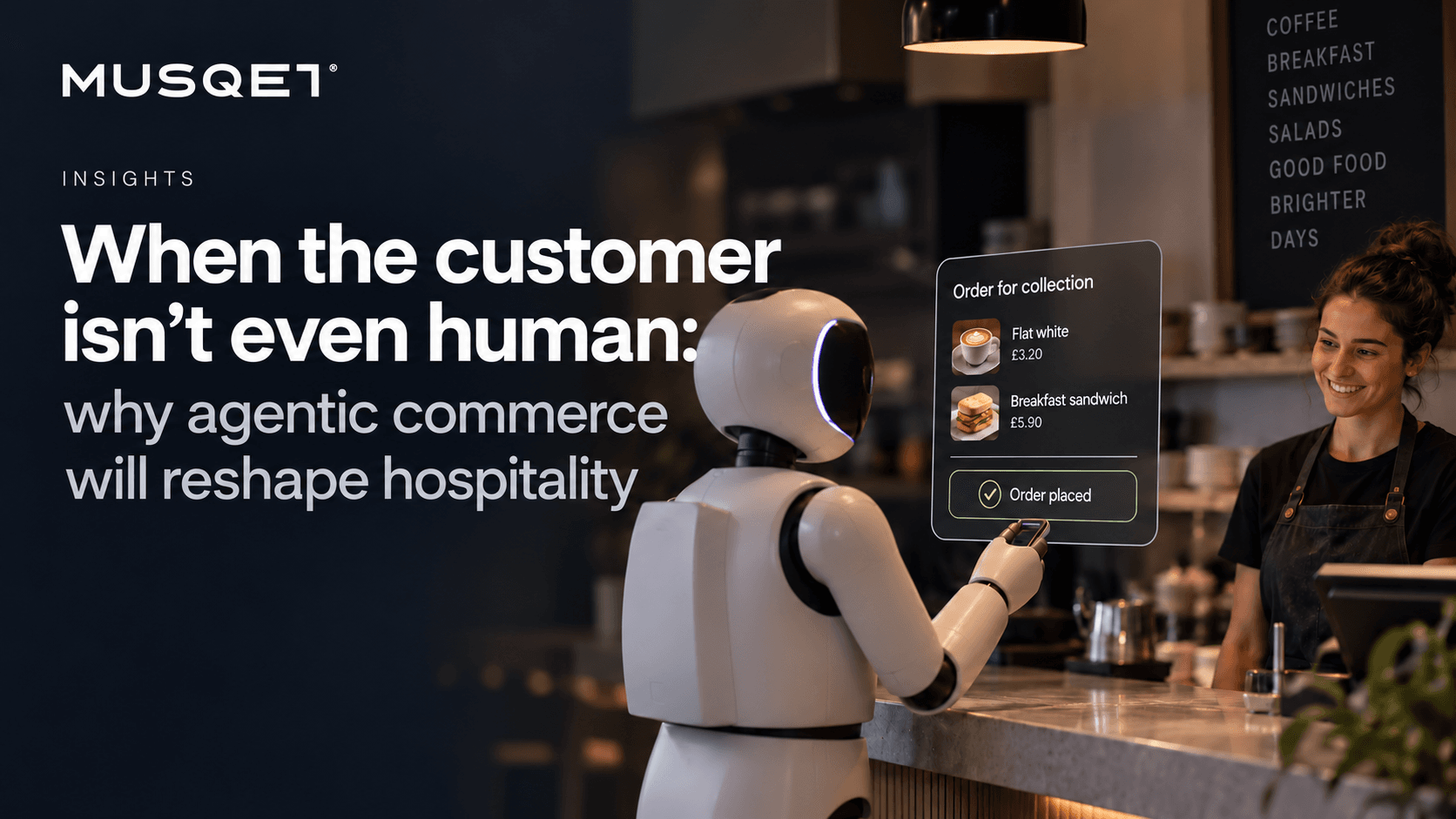
AI agents are moving from answering questions to acting on them: finding, comparing and buying on someone's behalf. The customer still decides what they want however the agent is now the one "surfing the internet", making recommendations and in increasingly more cases, selecting the product or service and completing the transaction. This is agentic commerce.
The question for every merchant is no longer only whether a customer can buy from them, but whether the customer's agent can.
Agents are learning to buy
Most people still use AI systems like an advanced search engine, and if you ask an agent to order lunch today, more often than not, it hands you a link for you to complete the transaction. That is just search with better manners. The real shift comes when the agent can see what merchants sell, trust the price and availability, and pay without a person filling in a form or going to another website.
The infrastructure underpinning it is arriving fast. Google's Universal Commerce Protocol (UCP) and OpenAI's Agentic Commerce Protocol (ACP) give agents a structured way to discover a catalogue, build a basket and check out.
The six layers of agent-readiness
In June, our CTO Ben de Waal published The Six Layers of Agent-Readiness, a shared framework for how ready a merchant really is to sell through agents. Its central point is that readiness is not binary. It is a stack, and most merchants sit somewhere in the middle of it.
- Feed presence. Visible in the discovery systems agents draw on.
- Structured data. Product pages a machine can read without guessing.
- Agent-discovery files. llms.txt, .well-known endpoints and MCP servers that tell agents how to talk to you.
- Programmatic access. Fresh prices and stock through APIs and webhooks, not scraping.
- AI-native content. Descriptions written for an agent that has to explain who a product suits, and when not to choose it.
- Agentic checkout. The agent can actually complete the purchase.
Layers one to five decide whether an agent can find you. Layer six decides whether it can buy.
Hospitality needs a seventh layer the framework stops short of: live stock, opening hours, kitchen queue depth and a collection time the venue can actually keep. Layers one to six make a venue findable and payable. Layer seven makes the promise real, and it can only be built from the till.
Why hospitality is different
A restaurant's menu could change frequently. An agent asking for "a coffee and a sandwich on my way to work" needs live availability, a price it can trust, and an order that lands on the till and in the kitchen so staff can make it. That makes hospitality the hardest test of agentic commerce, and the till its most important system.
Agents on both sides of the counter
A hospitality business is a run of trading periods: the Friday rush, the bank holiday, the cup final, the wet Tuesday in February. Each one is won or lost in the planning. Order too little and you turn guests away; order too much and margin ends up in the bin. A thin rota hurts service; a heavy one eats the week's profit. Most operators plan these periods on instinct, spreadsheets and memories of last year. Agents can plan and forecast them on data.
That is what the Musqet agentic fleet is being built to change: 15 specialist agents working from the venue's own till, kitchen and payments data. A General Manager agent coordinates the rest and holds a single conversation with the operator.
- Sense. Market Context watches what history cannot see: weather, fixtures, festivals, bank holidays, school terms and rail strikes, resolved to each venue's catchment. Demand Forecasting turns that into covers, revenue and item mix by daypart. Margin & Cost and Anomaly & Loss watch the numbers underneath.
- Plan. Labour & Rota drafts the rota against the forecast. Procurement & Stock drafts the orders. Menu & Pricing proposes substitutions when an ingredient turns uneconomic.
- Execute. Service & Capacity watches the kitchen queue and publishes ready-times the kitchen can keep. Agentic Commerce makes the venue orderable by customers' agents and puts their orders straight onto the kitchen screen.
- Assure. Compliance & Safety covers temperatures, allergens and audit packs. Cash & Reconciliation matches takings to settlement and invoices to deliveries.
- Grow. Reputation ties reviews back to the shift that produced them. Revenue & Offer builds promotions for quiet periods.
- Govern. A Supervisor agent monitors the fleet itself and tracks how often people overrule it.
Take a televised England match. Market Context flags it days ahead, knowing a sports pub near the ground will fill while a restaurant four miles away empties. Procurement drafts the order inside the supplier's lead time, Labour & Rota adds bar staff, and Revenue & Offer drafts the match-day deal. Or unit cost prices jump, and Menu & Pricing sets out the choice plainly: switch input cost item A to cost item B for a few weeks, raise the price, or absorb the hit to profitability.
Trust is the product
None of this works unless the operator stays in charge. Authority is earned in steps: observe, then draft, then act inside limits the operator sets, such as spend caps and approved suppliers. Paying a supplier, running payroll or raising a price is never autonomous, and an agent only gains freedom when people rarely need to overrule it. Every action is logged against the P&L.
What this means for operators
The venues that win the next decade will be easy for agents to buy from, and will use agents to run tighter trading periods. The same live data that lets a customer's agent order a sandwich is the data that lets your own agents forecast Saturday.
The Musqet agentic fleet arrives in 2027. The groundwork starts now: a modern ePOS, clean product data, and payments built for people and agents alike. If you want to know where your business sits on the six layers, talk to us.