Recently, one of our sales people called a UK workwear retailer to outline the Musqet gateway, payment platform capabilities and most excitedly, our agentic commerce offering. The merchant cut him off: "we're already agentic enabled thanks." The discussion continued and when pressed, there were some significant gaps as all the merchant had done was ask ChatGPT to recommend some headphones, the AI suggested their shop amongst others and seemed to know their product range. That was sufficient evidence to declare "agent ready" capability.
At first, it sounds like a win and in a small way, it is: agents can find them. But it's not what "agent-ready" means, and the gap between what they have and what they think they have is going to matter to their business soon.
This is happening across global ecommerce right now. Merchants are watching agentic shopping arrive, where AI assistants have moved from recommending products to buying them, and they're trying to work out where they stand. Most are landing on "we're fine" from partial evidence, and few of them are right.
We think the industry needs a clearer framework for this. So here it is: the six layers we believe define what it means to be agent-ready as a merchant, and how to tell where you actually sit.
Why the question matters now
The way people find and buy things online is changing.
For two decades, the dominant flow has been: customer types a query into Google, scans results, clicks a product, navigates a website, completes a checkout. Every layer of ecommerce, SEO, paid search, conversion-rate optimisation, is built around that pattern.
Agents break the pattern. A customer says "find me a black softshell jacket for under £100" to ChatGPT, Claude, Perplexity, or any of a growing list of AI products, and the agent does the searching, the comparing and the buying. The customer never needs to visit the merchant's site. They may never see the merchant's brand at all.
This is already happening, though it hasn't run in a straight line. OpenAI launched Instant Checkout inside ChatGPT in September 2025, in the US, built on the Agentic Commerce Protocol it developed with Stripe. It started with Etsy sellers and later a large Walmart catalogue, with more than a million Shopify merchants promised to follow. Six months in, only around thirty Shopify merchants were live. Selection stayed thin and onboarding was slow. Worse, people were using ChatGPT to research a purchase and then buying it elsewhere. By March 2026 OpenAI had stepped back, refocusing on product discovery and moving the buying itself into connected retailer apps rather than the chat.
That step back is the useful signal. The company furthest ahead on agentic checkout found the rest of the stack wasn't ready to carry it, with merchant data and product discovery still patchy underneath. Google, meanwhile, launched the Universal Commerce Protocol with Shopify at NRF this year, and the card networks are publishing their own agent-payment standards. The infrastructure is being built right now, in fits and starts, and the merchants who get ready early will be the ones standing in the right place when it settles.
The merchant who said to us "we're agentic enabled" wasn't lying. They were just operating with an incomplete model and a flawed understanding of what agentic commerce actually is. So let's build a better one.
The six layers
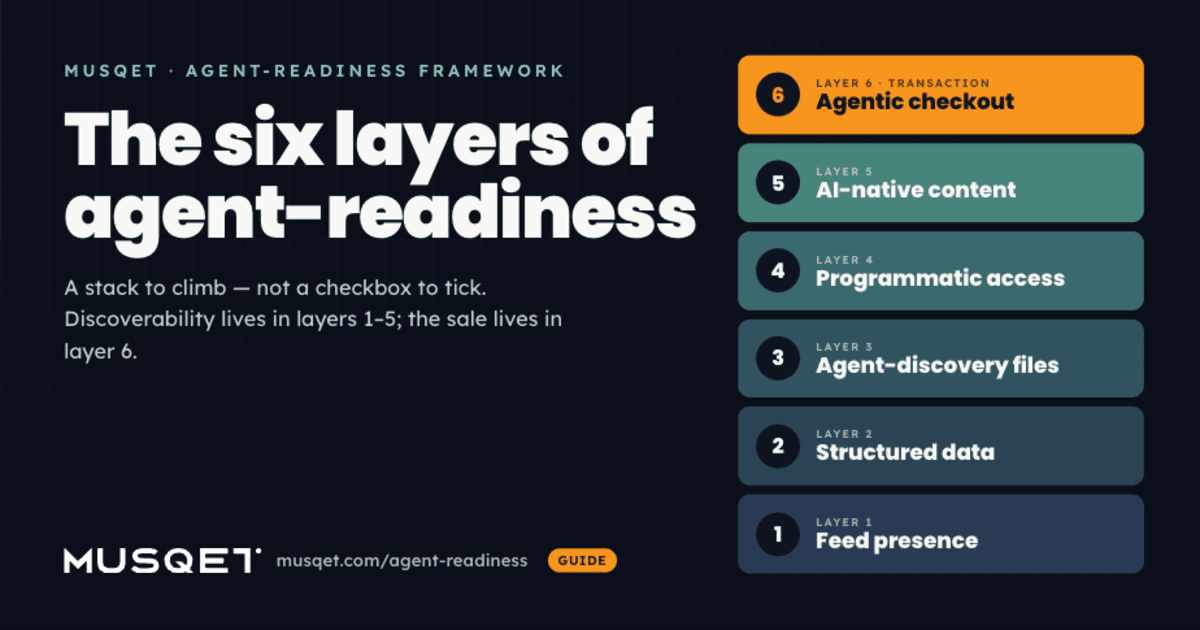
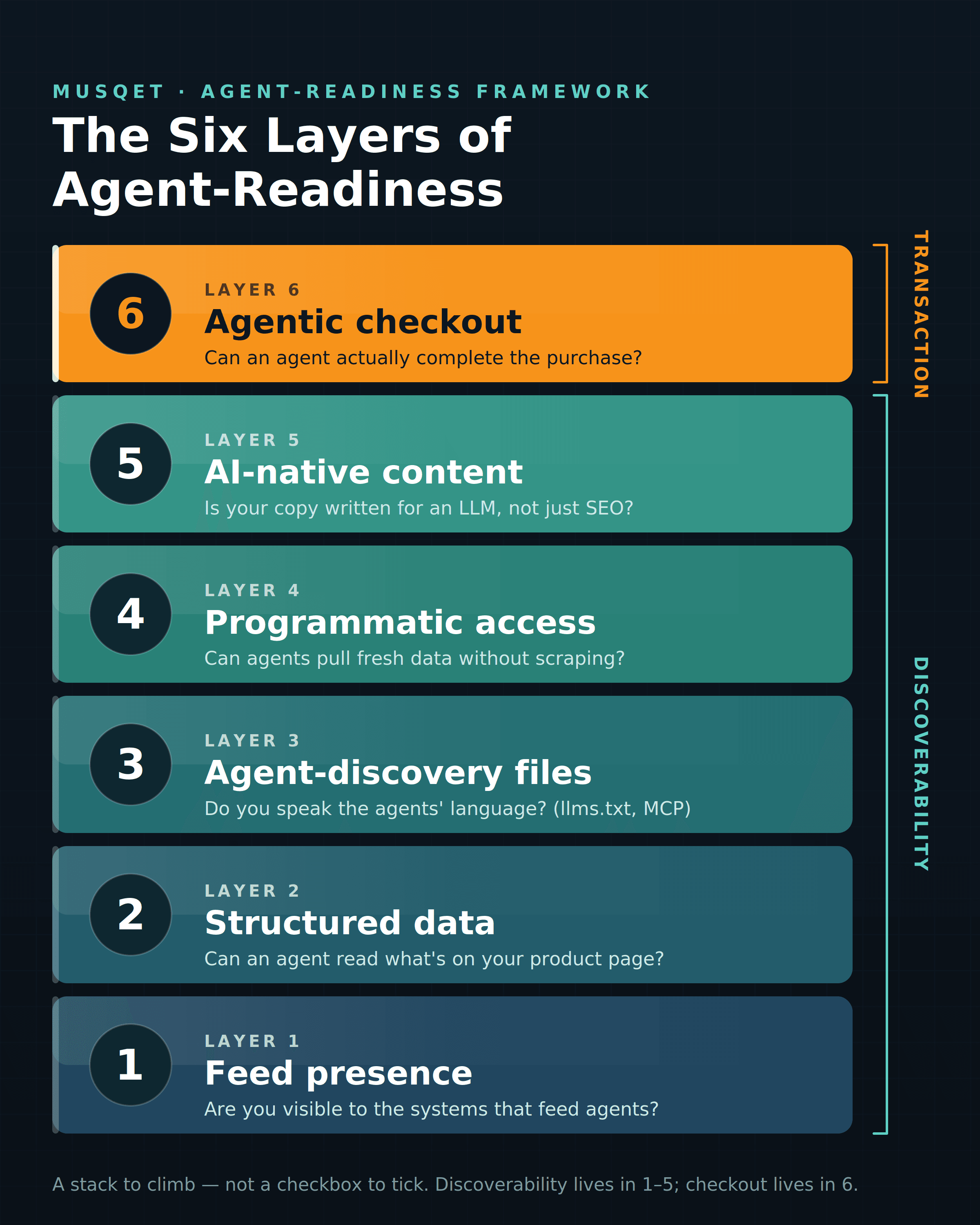
Agent-readiness isn't binary. It's a stack, and merchants sit at different heights on it. Each layer addresses a different question that an AI agent, or the system behind it, has to answer when deciding whether to recommend a merchant and whether to actually complete a purchase.
Layer 1Feed presence
Are you visible to the discovery systems that feed AI agents? This is Google Merchant Center, Bing Shopping, Meta Commerce, OpenAI's product graph. If you're not in these, you don't exist to agents. These are the table stakes. Most established merchants do this; many smaller ones don't.
Layer 2Structured data
When an agent lands on your product page, can it read what's there? schema.org
markup, Product, Offer,
AggregateRating, BreadcrumbList,
FAQPage, is how a machine knows that this page is a £74.99 black
softshell jacket in stock for next-day delivery, rather than a page that happens to contain those
words. Sloppy or missing structured data means agents misrepresent your products, recommend the
wrong sizes, or skip you entirely.
Layer 3Agent-discovery files
This is the newest layer, and almost no UK ecommerce merchant has touched it yet. We're
talking about llms.txt (think robots.txt for AI),
.well-known/ endpoints that advertise agent capabilities, and Model Context
Protocol servers that let agents query your catalogue directly through a standardised interface.
Anthropic published MCP as an open standard last year and it's gaining serious adoption. A merchant
with an MCP server is telling every AI ecosystem in the world: "we speak your
language." Almost nobody has done this, which leaves the next twelve months wide open for the
merchants who do.
Layer 4Programmatic access
Beyond the discovery files, can agents actually get fresh data efficiently? A public product API, a
clean sitemap with proper lastmod timestamps, webhooks for inventory and
price changes: these let agents stay current without scraping. Most modern ecommerce platforms have
these capabilities; very few merchants expose them deliberately, and fewer still document them.
Layer 5AI-native content
This one is more subjective but it matters. Were your product descriptions written for keyword-stuffing SEO, or for an LLM that's going to summarise the product to a customer? An agent recommending a softshell jacket needs to know what it's for, who it suits and when not to choose it. Most product copy answers none of that. Comparison content, sizing guides and real spec data a machine can read: that is what wins agent recommendations.
Layer 6Agentic checkout
Finally: can an agent complete a purchase with you? This is where the protocols actually bite. OpenAI's Agentic Commerce Protocol (ACP), developed with Stripe, and Google's Universal Commerce Protocol (UCP) are the emerging standards for letting a purchase complete through an agent rather than on your own site. They're early and still shifting in scope, as OpenAI's pullback from in-chat checkout shows, and today they're mostly US-only. The direction is set, though, and Musqet is building so its merchants are ready when it arrives.
That's the framework: six layers, each a capability gap you can measure. Discoverability lives in layers one to five; checkout lives in layer six.
What "passing" actually looks like
Take the merchant we mentioned at the start. They have Layer 1 (Google Merchant Center feed, evidently working, they show up in ChatGPT) and parts of Layer 2 (basic Product schema). They have nothing on Layer 3. Layer 4 is partial (Magento has a GraphQL API by default, but it's undocumented and not advertised). Layer 5 is patchy, and Layer 6 is absent.
That's a 2-out-of-6, roughly. They're discoverable but not navigable, and they're not transactable at all. When an agent says "I found this jacket at Merchant X for £74.99" and the customer says "great, buy it for me," the agent has to fall back to "I can't complete this purchase, here's the link", at which point you've reduced the agent to being a fancier Google.
A genuinely agent-ready merchant in 2026 would have all six layers in some form. Top-tier merchants
would have Layer 3 strongly developed, published MCP server, well-maintained
llms.txt, explicit AI-crawler policies in robots.txt.
They'd have rich AI-native content. And they'd have at least one of the agentic checkout protocols
live, even if they had to build it themselves.
We're aware of perhaps a handful of UK merchants who score above 5-out-of-6 on this framework. That's the opportunity for whoever moves first, and the risk for whoever moves last.
The technology gap that's about to widen
The gap between leading and trailing merchants is going to widen fast over the next eighteen months, and that is the uncomfortable part.
Layers 1 and 2 are commoditised. Any decent ecommerce platform handles these out of the box, and any decent agency can shore them up. There's no moat in being good at Layer 1.
Layers 3 through 6, though, require deliberate engineering investment. Building an MCP server for your catalogue isn't a plug-in. Getting onto ACP isn't a feature toggle. Writing AI-native content requires a different brief than writing SEO content. These take real work, and the merchants who start now will be six to twelve months ahead of the ones who wait.
By the time "everyone's doing it," the merchants who started early will have discovery surfaces that work, checkout integrations that are tested, and something money can't buy: real experience of how agentic traffic behaves and converts. That experience compounds. You can't buy it; you have to live through it.
Where merchants should start
Start with an honest audit, and honest means more than "we have a Google feed, so we're fine." Score each layer from zero to ten, specific about what is there and what isn't. Most merchants are surprised by what comes up.
Then put the weight on Layer 3, where a serious merchant can get furthest ahead for the least effort.
Publishing an llms.txt, settling your AI-crawler policy, standing up an MCP
server for your catalogue: these are achievable, measurable steps almost no competitor has taken, and
the window for them being a real advantage rather than a baseline is maybe twelve to eighteen months.
The one thing to avoid is skipping ahead to Layer 6. Building agentic checkout when nobody can yet discover you is a fast lane onto a road that doesn't exist. Discovery first, then transaction. The whole stack matters.
Where this is going
We're publishing this framework because we think the industry needs a shared vocabulary for agent-readiness, and right now there isn't one. The conversations we're having with merchants need to be taken step by step, partly because the technology is genuinely new, partly because every vendor has their own self-serving definition of what "agent-ready" means. A merchant says "we're agentic enabled" and what they mean is "we appeared in a ChatGPT search once."
The six layers aren't perfect, and we'll refine them as the landscape evolves. But they're an honest attempt at a framework that lets a merchant (or a board, or an investor) ask "where do we actually stand?" and get a real answer.
If you're a merchant trying to figure out your position, the framework is yours to use. If you're a vendor pitching agent-readiness, we'd encourage you to be specific about which layers you address. And if you're a technology partner either covering payments, infrastructure or content, your job over the next two years is to help merchants climb this stack rather than claim they're already at the top.
We'll be writing more about each individual layer soon, with concrete guidance on what good looks like and how to get there.
Agents are already here. The merchants who treat agent-readiness as a stack to climb, and start climbing now, will be ready to sell through an agent while their competitors are still arguing about what it means.
Musqet is building payment infrastructure for the agentic era, including both card and Bitcoin Lightning payments with UCP integration. If you'd like to talk through where you sit on the six layers, get in touch.